
Generative Engine Optimization (GEO): The Complete Beginner’s Guide
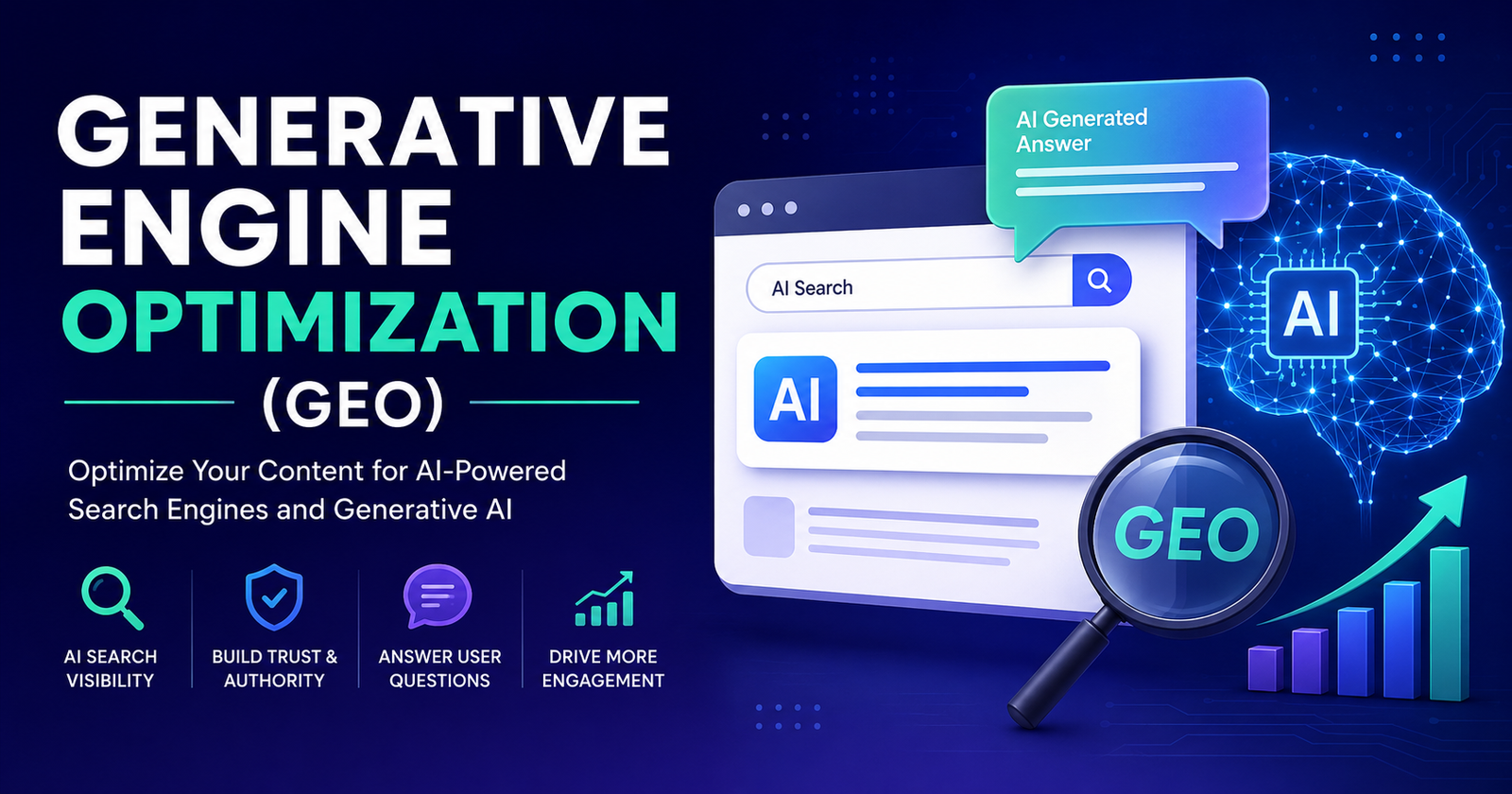
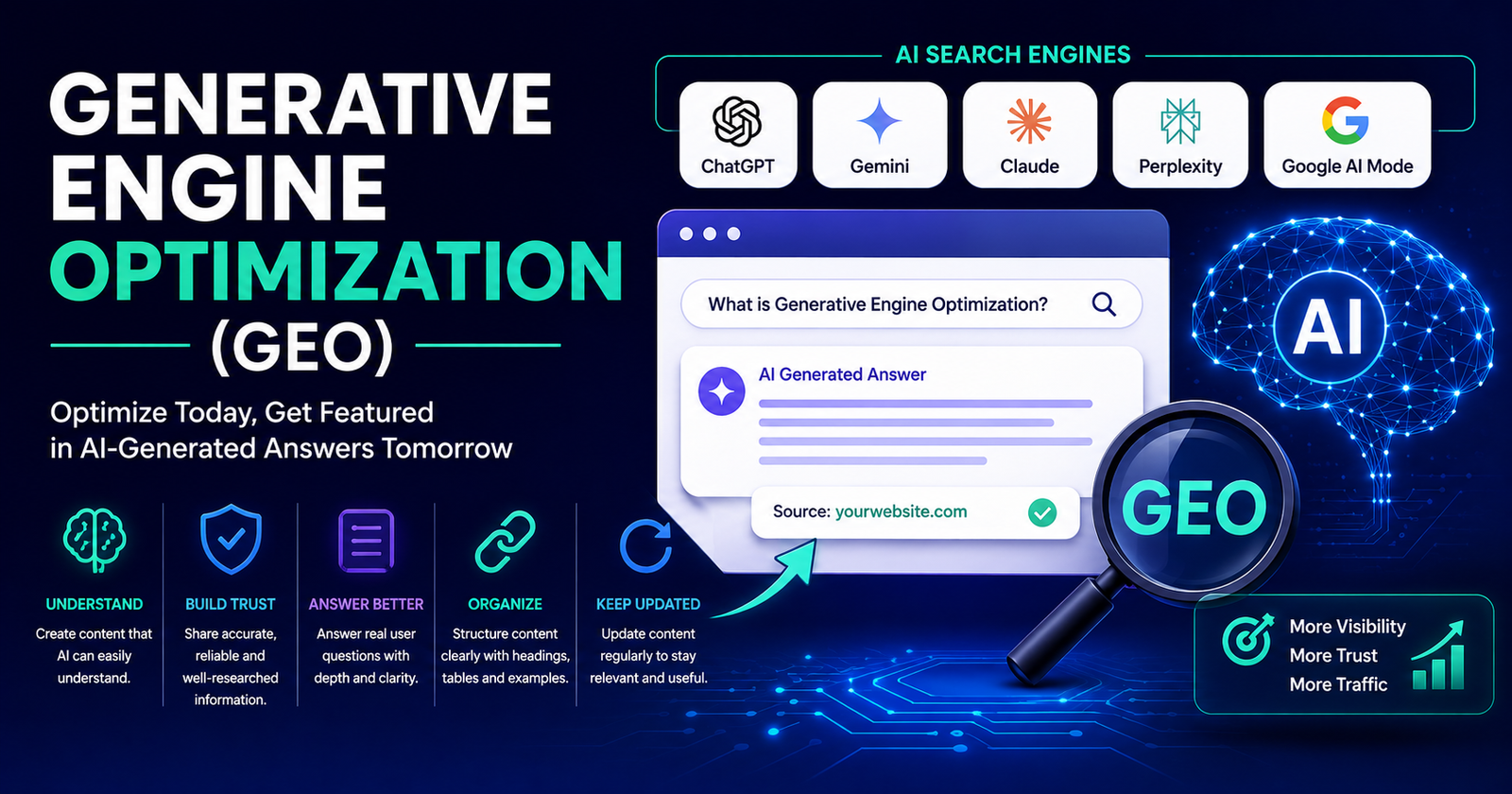
Search is changing faster than ever before. People no longer rely only on Google to find answers. Millions of users now ask questions directly to AI tools like ChatGPT, Google AI Mode, Gemini, Claude, and Perplexity. These AI platforms give direct answers instead of showing only a list of websites. This shift has created a new way to improve online visibility. It is called Generative Engine Optimization (GEO).
Generative Engine Optimization (GEO) helps your content become useful for AI-powered search engines. Instead of focusing only on ranking high in Google, GEO focuses on making your content easy for AI systems to understand, trust, and mention in their responses.
If you own a business, run a blog, or work in digital marketing, learning Generative Engine Optimization (GEO) is becoming more important every day. Websites that adapt early will have a better chance of getting traffic from AI search platforms.
In this guide, you will learn everything about Generative Engine Optimization (GEO), how it works, why it matters, and how you can use it to grow your website.
What Is Generative Engine Optimization (GEO)?
Generative Engine Optimization (GEO) is the process of creating and improving website content so AI search engines can easily understand it and use it when answering user questions.
Traditional SEO focuses on getting a webpage to rank on search engine result pages. GEO focuses on making content valuable enough that AI systems can summarize, quote, or recommend it when generating answers.
When someone asks an AI tool a question like:
“What are the best AI marketing strategies?”
the AI searches trusted information from many sources. It then creates a complete answer instead of showing only links.
If your website provides clear, accurate, and trustworthy information, there is a better chance that AI systems will use your content while generating responses.
This is the main goal of Generative Engine Optimization (GEO).
Unlike traditional search, AI looks for content that is easy to understand, well-structured, factually correct, and written for real people. AI also prefers content that answers questions directly instead of adding unnecessary words.
That is why GEO focuses on quality, trust, expertise, and user experience.
Why Generative Engine Optimization (GEO) Is Important in 2026
Artificial intelligence is changing how people search online. Instead of opening several websites, users now expect one complete answer from AI assistants.
This change is creating new opportunities for websites that produce helpful content.
Generative Engine Optimization (GEO) helps businesses stay visible even when users never visit a traditional search results page. If AI platforms regularly mention your content, your brand gains more trust and authority.
Many companies have already started creating GEO-friendly content because they know AI search will continue growing.
Several factors make Generative Engine Optimization (GEO) important today.
| Traditional SEO | Generative Engine Optimization (GEO) |
|---|---|
| Focuses on Google rankings | Focuses on AI-generated answers |
| Targets search engine results | Targets AI recommendations |
| Depends heavily on keywords | Depends on quality and context |
| Optimizes for clicks | Optimizes for citations and mentions |
| Builds backlinks | Builds authority and trust |
Businesses that combine SEO and GEO can reach users through both search engines and AI assistants.
Ignoring GEO today may reduce future visibility as AI becomes a bigger part of online search.
How Generative Engine Optimization (GEO) Works
To understand Generative Engine Optimization (GEO), it helps to know how AI search engines create answers.
Large language models collect information from trusted websites, structured data, knowledge databases, public sources, and other high-quality content. They analyze this information before generating responses.
AI systems do not simply copy articles. They understand topics, compare different sources, and create new answers using the information they trust.
Because of this, websites should focus on providing complete and reliable information instead of writing only for search engines.
A good GEO strategy includes clear headings, short paragraphs, accurate facts, updated information, and natural language.
AI also values content that answers common user questions directly. Articles that explain a topic step by step are often easier for AI to understand.
Another important part of Generative Engine Optimization (GEO) is building authority. Websites with expertise, original insights, trustworthy sources, and consistent publishing are more likely to become reliable references for AI-generated answers.
When your content becomes easy to understand and highly useful, AI systems are more likely to recognize its value.
Traditional SEO vs Generative Engine Optimization (GEO)
Many people think Generative Engine Optimization (GEO) will replace SEO. That is not true.
Instead, GEO builds on traditional SEO.
SEO still helps search engines discover and rank your website. GEO helps AI understand your content and include it in generated responses.
Today, successful websites use both strategies together.
SEO focuses on technical improvements like page speed, backlinks, mobile optimization, keywords, and indexing.
Generative Engine Optimization (GEO) focuses on content quality, semantic meaning, factual accuracy, topic depth, author credibility, and user satisfaction.
The future belongs to websites that combine both methods.
For example, if your article ranks well on Google and also provides complete answers that AI trusts, your website can receive traffic from both traditional search and AI-powered platforms.
This creates stronger long-term visibility and protects your website as search technology continues to evolve.
Core Principles of Generative Engine Optimization (GEO)
To succeed with Generative Engine Optimization (GEO), you need to understand what AI systems look for when they generate answers. Unlike traditional search engines, AI does not only count keywords or backlinks. It tries to understand the meaning of your content and whether it provides the best answer for a user’s question.
The first principle of Generative Engine Optimization (GEO) is writing for people before search engines. Your content should solve real problems using clear language. Avoid long and confusing sentences because AI prefers content that is easy to understand.
The second principle is building trust. AI platforms are more likely to use information from websites that show expertise, accuracy, and consistency. Regularly updating your articles also helps improve trust because AI values fresh information.
Another important principle is creating complete content. Instead of giving short answers, explain the topic from different angles. Include definitions, examples, comparisons, tables, and frequently asked questions. This makes your content more useful for readers and easier for AI to understand.
Finally, organize your content with clear headings and logical sections. A well-structured article helps both users and AI systems find information quickly.
How AI Search Engines Choose Content for Generative Engine Optimization (GEO)
Many website owners wonder how AI decides which content to mention in its answers. The exact process differs between platforms, but most AI systems look for similar quality signals.
Generative Engine Optimization (GEO) focuses on creating content that is clear, factual, and relevant. AI analyzes the meaning of your content instead of matching only exact keywords. It also checks whether your article answers the user’s question directly.
Content that includes real examples, updated facts, and detailed explanations usually performs better. AI also prefers articles that cover a topic completely instead of providing only basic information.
Another important factor is consistency. If your website regularly publishes high-quality content in the same niche, AI may see your site as a trusted source. For example, a technology blog that consistently publishes helpful AI articles is more likely to become an authority than a website that covers random topics.
AI also values content that avoids misleading claims. Always support important information with reliable sources when needed. Honest and balanced writing improves your credibility and supports your Generative Engine Optimization (GEO) strategy.
| AI Preference | Why It Matters for GEO |
|---|---|
| Clear language | Easy for AI to understand |
| Accurate information | Builds trust |
| Complete topic coverage | Improves answer quality |
| Updated content | Keeps information relevant |
| Good website authority | Increases credibility |
| Logical structure | Helps AI process information |
Best Practices for Generative Engine Optimization (GEO)
A successful Generative Engine Optimization (GEO) strategy depends on producing content that both readers and AI systems find valuable. The goal is not to trick AI but to create genuinely useful information.
Start every article with a clear introduction that explains what readers will learn. This helps AI identify the main topic immediately. Use descriptive headings that naturally include your primary keyword where it makes sense.
Write short paragraphs and simple sentences. This improves readability and allows AI to understand each section more easily. Add tables whenever they simplify complex information. Tables help readers compare ideas quickly and often improve content structure.
Keep your information accurate and update old articles whenever new developments appear. AI search platforms often prefer fresh and reliable content over outdated pages.
Internal linking is another important practice. Connect related articles on your website using descriptive anchor text. This helps users explore your content while showing AI the relationship between different topics.
Finally, focus on user intent. Think about the questions people ask before creating your content. When your article answers those questions clearly, your Generative Engine Optimization (GEO) efforts become much stronger.
How to Write Content for Generative Engine Optimization (GEO)
Writing for Generative Engine Optimization (GEO) is different from writing only for Google rankings. Instead of repeating keywords many times, focus on answering questions naturally and completely.
Begin with a simple definition of the topic. Then explain why it matters and how it works. Add practical examples so readers can understand the concept easily.
Use conversational language because AI models are trained on natural human communication. Avoid stuffing keywords into every sentence. Instead, include your primary keyword naturally throughout the article while also using related terms.
Each section should answer one important question. This structure makes your article easier for AI to analyze and summarize. Add comparison tables where helpful because structured information is easier to process.
When discussing technical topics, explain difficult terms in simple language. Many readers are beginners, and AI values content that is understandable for a wide audience.
Also include original insights whenever possible. Sharing your own experience, observations, or practical advice can make your content stand out. Unique content is more valuable than repeating information already available on hundreds of websites.
A well-written Generative Engine Optimization (GEO) article should educate, inform, and solve problems instead of simply trying to rank for a keyword.
Why User Experience Supports Generative Engine Optimization (GEO)
User experience plays a major role in Generative Engine Optimization (GEO). AI wants to recommend content that provides a positive experience for readers.
A clean website design makes content easier to read. Fast loading pages reduce frustration and encourage visitors to stay longer. Mobile-friendly layouts are also important because many users search from smartphones.
Readable formatting improves both user experience and AI understanding. Use headings, short paragraphs, tables, and highlighted important terms to make your content easy to scan.
Good user experience also includes trustworthy information. Avoid clickbait titles or exaggerated claims. Deliver exactly what your headline promises.
Another helpful practice is updating older articles with new information. AI prefers content that reflects current knowledge instead of outdated advice.
When readers spend more time on your website because they find your content helpful, it strengthens your overall content quality. While AI platforms use different systems than traditional search engines, creating content that people enjoy reading is always a smart strategy.
For this reason, Generative Engine Optimization (GEO) should always focus on helping users first. When readers benefit from your content, AI systems are also more likely to recognize its value.
Common Generative Engine Optimization (GEO) Mistakes to Avoid
Many website owners have started using Generative Engine Optimization (GEO), but some still make mistakes that reduce their chances of being mentioned by AI search engines. The biggest mistake is writing only for keywords instead of helping readers. AI systems understand meaning and context. If your content repeats the same keyword without adding value, it may not perform well.
Another common mistake is publishing thin content. Articles with very little information rarely become trusted resources. AI prefers detailed content that answers questions completely. Cover the topic from different angles instead of writing only a short explanation.
Many websites also forget to update old articles. Information changes quickly, especially in technology and AI. Regular updates show that your content is current and reliable. This supports your Generative Engine Optimization (GEO) strategy.
Poor formatting is another issue. Large blocks of text make reading difficult for both users and AI. Use headings, tables, short paragraphs, and highlighted important terms to improve readability.
Some people also make unrealistic claims without proof. Trust is one of the strongest signals for AI-generated answers. Always provide accurate information and avoid exaggeration. Building authority takes time, but it creates long-term success.
Advanced Strategies for Generative Engine Optimization (GEO)
Once you understand the basics, you can use advanced methods to improve your Generative Engine Optimization (GEO) results. These strategies help your content become more valuable for both readers and AI platforms.
One effective method is creating topic clusters. Instead of writing only one article, publish several related articles that connect through internal links. For example, if you write about GEO, you can also create articles about AI SEO, ChatGPT marketing, structured data, AI content writing, and search trends. This helps establish your website as an authority on the subject.
Another strategy is answering real user questions. Visit online communities, search forums, and Google’s “People Also Ask” section to discover what users want to know. Build your content around those questions.
Adding original research can also strengthen your content. Share your own experience, case studies, survey results, or practical observations. Original information gives AI something unique to reference.
Keep your writing simple and natural. AI understands conversational language very well. Avoid unnecessary jargon and focus on solving real problems.
Finally, maintain consistency. Publishing high-quality articles regularly helps build authority over time. A strong content library increases the chances that AI systems will recognize your expertise in Generative Engine Optimization (GEO) and related topics.
Best Tools for Generative Engine Optimization (GEO)
The right tools can make Generative Engine Optimization (GEO) easier. While no tool guarantees AI citations, many help improve your content quality, research, and optimization.
| Tool | How It Helps GEO |
|---|---|
| ChatGPT | Content research and idea generation |
| Google Search Console | Monitor website performance |
| Google Trends | Find trending search topics |
| Google Analytics | Understand visitor behavior |
| Ahrefs | Keyword and backlink research |
| Semrush | SEO audits and keyword analysis |
| Screaming Frog | Technical SEO checks |
| Grammarly | Improve grammar and readability |
| PageSpeed Insights | Improve website speed |
These tools support different parts of your Generative Engine Optimization (GEO) strategy. Some improve technical SEO, while others help create better content or discover new topics.
Remember that tools are only assistants. High-quality writing, accurate information, and user-focused content remain the most important factors.
Real Examples of Generative Engine Optimization (GEO) in Action
Imagine two websites that both publish an article about artificial intelligence.
The first website writes only 600 words with repeated keywords and very little explanation. It has no headings, no examples, and no updates.
The second website publishes a complete guide with clear headings, useful tables, practical examples, frequently asked questions, and updated information. It explains every concept in simple language and answers common user questions.
Which article is more helpful?
Most readers will prefer the second article. AI systems are also more likely to understand and reference the second article because it provides complete and trustworthy information.
Another example involves an online business. A software company creates detailed tutorials, troubleshooting guides, and product documentation. Instead of focusing only on promotional content, the company solves customer problems. Over time, AI systems recognize this helpful content as a reliable source.
These examples show that Generative Engine Optimization (GEO) rewards quality rather than shortcuts. Websites that consistently educate readers are more likely to appear in AI-generated answers.
The Future of Generative Engine Optimization (GEO)
The future of online search is closely connected to artificial intelligence. More users are asking questions through AI assistants instead of typing short keywords into traditional search engines. This trend is expected to continue as AI becomes more accurate and widely available.
Because of this shift, Generative Engine Optimization (GEO) will become an important part of every digital marketing strategy. Businesses that prepare now will have a stronger chance of reaching future audiences.
Search engines are also combining traditional search with AI-generated answers. This means websites should not choose between SEO and GEO. Instead, they should use both together. Technical SEO helps search engines discover your pages, while GEO helps AI understand and recommend your content.
Content quality will remain the biggest factor. AI models continue to improve their ability to identify useful, trustworthy, and well-organized information. Websites that focus on helping users instead of manipulating algorithms will have the greatest long-term success.
As AI technology evolves, Generative Engine Optimization (GEO) will also evolve. Staying informed, updating your content, and creating helpful resources will keep your website competitive in the years ahead.
Conclusion
Generative Engine Optimization (GEO) is changing the way websites gain visibility online. Instead of focusing only on search engine rankings, GEO helps your content become useful for AI-powered search platforms such as ChatGPT, Google AI Mode, Gemini, Claude, and Perplexity.
The key to successful Generative Engine Optimization (GEO) is simple. Create content that is accurate, trustworthy, easy to read, and genuinely helpful. Use clear headings, answer real questions, organize information well, and update your articles regularly.
Traditional SEO is still important, but it is no longer enough on its own. Combining SEO with Generative Engine Optimization (GEO) gives your website a better chance of reaching users through both search engines and AI assistants.
As AI continues to transform digital search, websites that focus on quality, authority, and user value will have the best opportunity to grow. Start applying Generative Engine Optimization (GEO) today, and your content will be better prepared for the future of search.
Frequently Asked Questions (FAQs)
What is Generative Engine Optimization (GEO)?
Generative Engine Optimization (GEO) is the process of optimizing website content so AI-powered search engines can understand, trust, and use it when generating answers for users.
Is Generative Engine Optimization (GEO) replacing SEO?
No. Generative Engine Optimization (GEO) does not replace SEO. Instead, it works alongside traditional SEO. SEO helps websites rank in search engines, while GEO helps content appear in AI-generated responses.
Which AI platforms use Generative Engine Optimization (GEO)?
Content optimized for Generative Engine Optimization (GEO) can improve visibility on AI-powered platforms such as ChatGPT, Google AI Mode, Gemini, Claude, Perplexity, and future AI search systems.
How can I improve my Generative Engine Optimization (GEO)?
You can improve Generative Engine Optimization (GEO) by creating high-quality content, answering user questions clearly, using proper headings, adding structured information, keeping content updated, and building website authority.
Why is Generative Engine Optimization (GEO) important for businesses?
Generative Engine Optimization (GEO) helps businesses stay visible as more people use AI assistants instead of traditional search engines. It increases brand awareness, builds trust, and creates new opportunities to attract visitors through AI-generated answers.