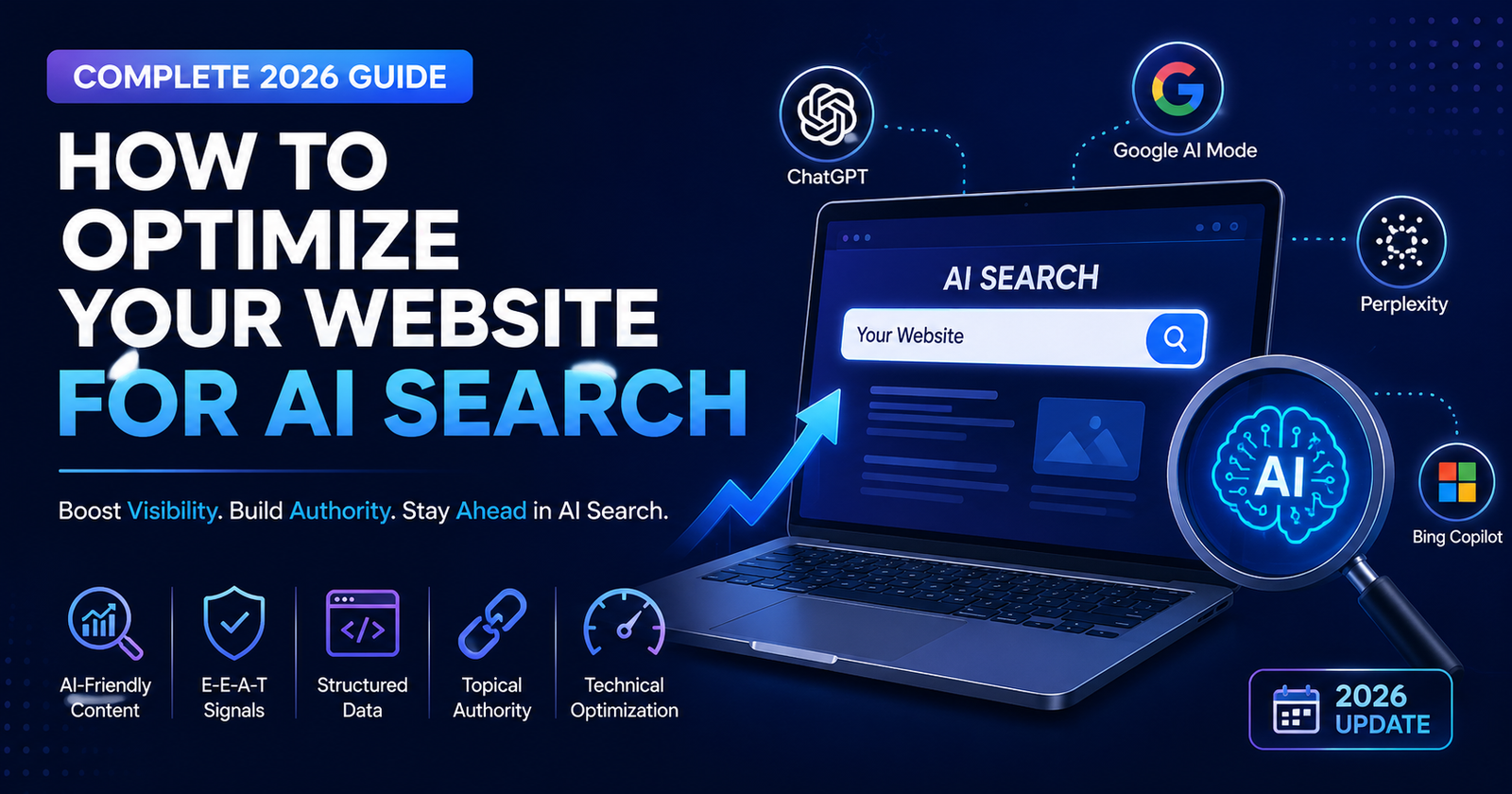
Artificial intelligence is changing the way people search online. Today, many users ask questions in ChatGPT, Google AI Mode, Gemini, Claude, and Perplexity instead of using traditional search engines. These AI tools do not only show a list of links. They also provide direct answers by collecting information from trusted websites.
This change creates a new opportunity for website owners. If you know how to optimize your website for AI search, your content has a better chance of being mentioned in AI-generated answers. This can bring more visitors, increase your brand authority, and improve your online visibility.
Traditional SEO still matters. However, AI search looks beyond keywords. It prefers content that is helpful, clear, trustworthy, and easy to understand. Websites that answer real questions in simple language often perform better.
In this guide, you will learn how to optimize your website for AI search using practical strategies that work in 2026. Whether you own a blog, business website, or eCommerce store, these tips will help your content stay visible as search continues to evolve.
What Is AI Search?
AI search is a new way of finding information online. Instead of showing only web pages, AI search understands the user’s question and creates a complete answer using information from trusted sources.
Popular AI search tools include ChatGPT, Google AI Mode, Gemini, Claude, Microsoft Copilot, and Perplexity. These platforms read web content, understand context, compare different sources, and then generate a helpful response.
Unlike traditional search engines, AI search focuses on understanding meaning instead of matching exact keywords. This means your website should answer questions naturally and clearly.
Here is a simple comparison between traditional search and AI search.
| Feature | Traditional Search | AI Search |
|---|---|---|
| Results | List of web pages | Direct AI-generated answers |
| Focus | Keywords | User intent and context |
| Ranking | SEO signals | Content quality and authority |
| User Experience | Click different websites | Get complete answers instantly |
| Best Content | Keyword-rich pages | Helpful and trustworthy content |
Understanding this difference is the first step in learning how to optimize your website for AI search. Your goal is no longer to rank only on Google. Your goal is to become a trusted source that AI systems choose when generating answers.
Why Learning How to Optimize Your Website for AI Search Matters
AI-powered search is growing rapidly. Millions of people now ask AI assistants for product recommendations, tutorials, comparisons, and buying advice every day.
When AI tools trust your website, they may use your content while answering user questions. This increases your brand exposure even if users never perform a traditional Google search.
Businesses that start optimizing today will have a strong advantage over competitors who still focus only on old SEO methods.
Here are some of the biggest benefits.
| Benefit | Why It Matters |
|---|---|
| More Visibility | Your website can appear in AI-generated answers. |
| Better Trust | AI systems prefer reliable and accurate sources. |
| Higher Organic Traffic | More people discover your content naturally. |
| Strong Brand Authority | Your website becomes a trusted information source. |
| Future-Proof SEO | Your strategy stays effective as search evolves. |
Learning how to optimize your website for AI search is not replacing SEO. Instead, it adds another layer that prepares your website for the future of search.
How AI Search Chooses Websites
Many website owners think AI search works exactly like Google rankings. That is not true.
AI models look for content that answers questions completely. They also check whether the information is accurate, well-structured, and easy to understand.
Several factors help AI decide which websites to trust.
The website should have clear headings that organize information logically. The content should answer the user’s question without unnecessary words. Facts should be correct and updated regularly. The writing should be natural instead of stuffed with keywords.
AI also looks at the overall authority of a website. A site that regularly publishes high-quality articles is more likely to become a trusted source.
The table below explains what AI systems usually prefer.
| AI Preference | Why It Helps |
|---|---|
| Helpful content | Answers user questions completely |
| Clear structure | Makes information easy to understand |
| Updated articles | Keeps facts accurate |
| Fast website | Improves user experience |
| Mobile-friendly pages | Works well on all devices |
| Trusted sources | Increases credibility |
| Natural language | Matches conversational AI responses |
If you want to master how to optimize your website for AI search, always create content that helps people first. Search engines and AI systems reward websites that provide genuine value.
Create Helpful Content That Solves Real Problems
The most important rule in AI search optimization is simple. Help the reader.
Every article should solve a real problem. Before writing, ask yourself what information users actually need.
For example, someone searching how to optimize your website for AI search wants practical advice. They do not want a page filled with repeated keywords or long introductions that add no value.
Your content should explain the topic clearly from beginning to end. Use simple words. Give real examples. Explain difficult ideas in an easy way.
Instead of writing only general information, answer specific questions that readers may have.
For example:
- What is AI search?
- How does AI search work?
- What is the difference between SEO and AI search optimization?
- Which ranking factors matter most?
- How can beginners optimize their websites?
When your article answers these questions naturally, readers stay longer on your website. This also increases the chances that AI systems will use your content as a trusted reference.
Always remember that quality beats quantity. One detailed and helpful article performs better than several short articles with little value.
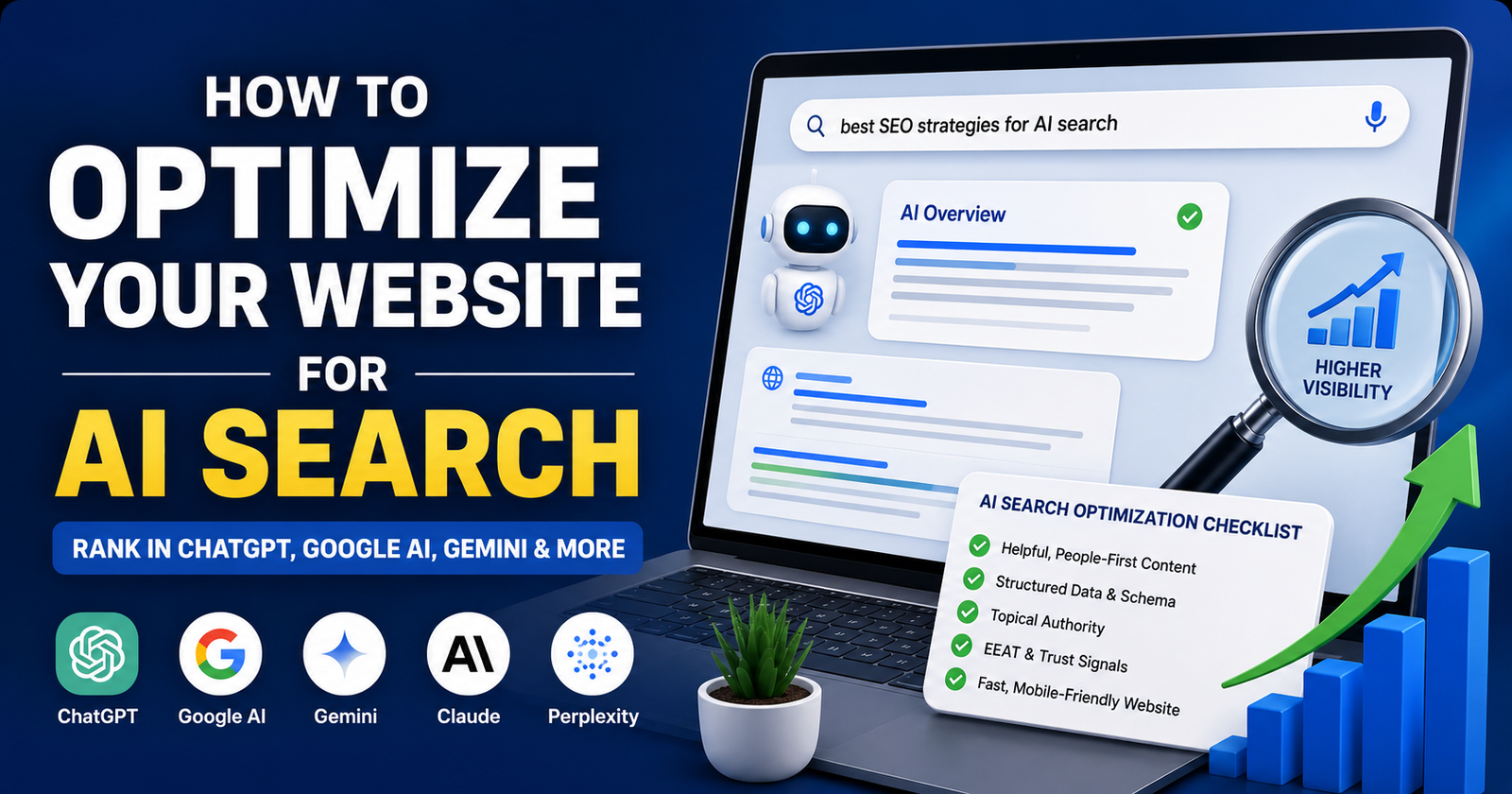
How to Optimize Your Website for AI Search Using Structured Data
One of the smartest ways to improve how to optimize your website for AI search is by using structured data. Structured data helps search engines understand your content better. It adds extra information to your web pages in a format that machines can read easily.
AI search systems want clear and accurate information. When your website uses structured data, it becomes easier for AI tools to identify important details such as the article title, author, publication date, FAQs, reviews, products, and business information.
For example, if you publish a guide, Article schema tells search engines that the page is an informative article. If you run an online store, Product schema explains the product name, price, and availability.
Structured data does not guarantee higher rankings. However, it increases the chances that your content will be understood correctly by AI systems.
The table below shows some common schema types.
| Schema Type | Best Used For | Benefit for AI Search |
|---|---|---|
| Article | Blog posts | Helps AI understand article content |
| FAQ | Frequently asked questions | Makes question-answer content easier to use |
| Product | Online stores | Displays product information clearly |
| Organization | Business websites | Improves business credibility |
| Local Business | Local companies | Supports local AI search results |
| Breadcrumb | All websites | Improves website structure |
| Review | Products and services | Builds trust with users and AI |
If you are learning how to optimize your website for AI search, structured data should become a regular part of your SEO strategy.
Build Topical Authority Instead of Writing Random Articles
Many websites publish articles without a clear plan. One day they write about SEO. The next day they write about health or travel. This approach makes it harder for AI systems to understand what the website specializes in.
AI search prefers websites that show deep knowledge about one subject. This is called topical authority.
If your website focuses on digital marketing, create multiple articles around related topics. Cover every important question that users may ask.
For example, instead of publishing only one article about AI search, build a complete content hub.
| Main Topic | Supporting Articles |
|---|---|
| AI Search | What Is AI Search? |
| AI Search | How AI Search Works |
| AI Search | AI Search vs Traditional SEO |
| AI Search | GEO Best Practices |
| AI Search | AI Content Optimization |
| AI Search | Schema Markup Guide |
| AI Search | AI SEO Tools |
| AI Search | Future of AI Search |
This content structure helps AI understand that your website is an expert on the topic.
When people search similar questions, AI systems are more likely to trust your content.
Building topical authority is one of the strongest long-term strategies for how to optimize your website for AI search.
Use Natural Language Instead of Keyword Stuffing
Years ago, many websites repeated the same keyword many times because search engines relied heavily on keyword matching.
Today, AI understands language much better. It recognizes synonyms, context, and user intent.
That means your writing should sound natural.
Instead of repeating how to optimize your website for AI search in every sentence, mix it with related phrases such as:
- AI search optimization
- AI SEO
- optimize for ChatGPT
- optimize for Google AI
- Generative Engine Optimization
- AI-friendly website
- AI content optimization
This makes your article easier to read while still helping search engines understand the topic.
Always write as if you are explaining the subject to a real person.
Natural writing improves user experience and increases the likelihood that AI assistants will quote or reference your content.
Improve EEAT to Build Trust with AI Search
Trust is one of the biggest ranking signals in modern search.
Google introduced the concept of EEAT, which stands for Experience, Expertise, Authoritativeness, and Trustworthiness. Although different AI platforms use different systems, they all value reliable information.
You can improve EEAT by showing who wrote the article and why they are qualified to discuss the topic. Add an author profile with experience and credentials where relevant.
Keep your articles updated. Remove outdated information and replace it with current facts.
Support important claims with reliable sources. When readers trust your content, AI systems are also more likely to view your website as dependable.
Other ways to improve EEAT include publishing original research, sharing real examples, writing detailed guides, maintaining a professional website design, and ensuring your contact information is easy to find.
If your website becomes known for accurate information, it has a much better chance of appearing in AI-generated responses.
Learning how to optimize your website for AI search is not just about technical SEO. It is also about becoming a trusted source of information.
Create AI-Friendly Content Structure
AI systems scan articles quickly.
A page with long paragraphs and poor formatting is harder to understand.
Well-structured content improves readability for both users and AI.
Use descriptive headings that explain each section clearly.
Keep paragraphs short.
Use tables whenever they make information easier to compare.
Answer questions directly before adding extra explanation.
Write one idea at a time.
Here is an example of an AI-friendly article structure.
| Section | Purpose |
|---|---|
| Introduction | Explain the topic clearly |
| H2 Heading | Cover one main idea |
| H3 Heading | Explain smaller concepts |
| Table | Compare important information |
| FAQ | Answer common questions |
| Conclusion | Summarize the article |
A clean structure allows AI tools to understand your content more accurately.
This is one of the easiest improvements you can make when learning how to optimize your website for AI search.
Strengthen Internal Linking Across Your Website
Internal links help users discover more content. They also help AI understand the relationship between your articles.
For example, if you publish an article about AI search, you can naturally link to related guides about SEO, GEO, keyword research, technical SEO, and content marketing.
These links create a strong knowledge network across your website.
Do not add links randomly.
Every internal link should help readers learn more about the topic.
Use descriptive anchor text instead of generic phrases like “click here.”
Examples of strong anchor text include AI SEO Guide, Generative Engine Optimization, Technical SEO Checklist, or Content Marketing Strategy.
A well-connected website is easier for search engines to crawl and easier for AI systems to understand.
Strong internal linking also encourages visitors to spend more time on your website, which improves engagement.
Keep Your Website Fast, Secure, and Mobile-Friendly
Content quality is essential, but technical performance also matters.
AI search systems prefer websites that provide a smooth user experience.
A slow website can frustrate visitors and increase bounce rates.
Make sure your pages load quickly on both desktop and mobile devices.
Compress images without reducing quality.
Use browser caching and modern image formats where possible.
Choose reliable hosting with good uptime.
Your website should also use HTTPS to keep visitor data secure.
Most users now browse on smartphones, so responsive design is essential.
The table below highlights key technical factors.
| Technical Factor | Why It Matters |
|---|---|
| Fast loading speed | Improves user experience |
| Mobile responsiveness | Supports all screen sizes |
| HTTPS security | Builds trust |
| Clean URL structure | Easier for AI to understand |
| XML sitemap | Helps discover content |
| Robots.txt | Guides search crawlers |
| Core Web Vitals | Measures page performance |
Technical optimization supports every other effort you make in how to optimize your website for AI search.